When Law Redefines Anatomy
“Vagina”, “Vulva” and the Public Knowledge of Bodies
Content note: this article discusses sexual-offences law, forensic medical evidence, genital anatomy and historical censorship of medical illustrations.
Most people use the word “vagina” in ordinary speech without stopping to ask whether they mean the internal anatomical canal, the visible external genitalia, or the genital region more generally. In casual conversation, that imprecision may not always matter. In medicine, law, education and courtrooms, however, it can matter a great deal.
A small word can carry different meanings in different systems of authority. In anatomical usage, the vagina and vulva are distinct. The vagina is the internal muscular canal leading from the cervix to the outside of the body. The vulva refers to the external genital structures, including the labia, clitoris, urethral opening and vaginal opening.
UK sexual-offences legislation does not use the word “vagina” in that strictly anatomical way. Across the sexual-offences frameworks for England and Wales, Scotland and Northern Ireland, the legal meaning is expanded for statutory purposes. In England and Wales, the Sexual Offences Act 2003 states both that references to a body part include surgically constructed body parts and that “vagina” includes vulva. Northern Ireland’s Sexual Offences Order 2008 contains similar general wording about surgically constructed body parts and also states that “vagina” includes vulva. Scotland’s Sexual Offences Act 2009 defines “vagina”, for the purposes of the rape provision, as including the vulva and a surgically constructed vagina, together with any surgically constructed vulva.
That is not merely genital trivia. It is a practical example of how law can redefine anatomy.
A courtroom problem hidden inside a familiar word
A forensic medical professional giving evidence in a sexual-offences trial may be asked a seemingly simple question: “What is a vagina?”
The question is not simple. A medical answer and a legal answer may both be correct, yet they may not be identical. A doctor trained in anatomy might naturally distinguish the vagina from the vulva. A lawyer may be working from a statutory definition in which the vulva is expressly included within the legal meaning of “vagina”. A jury may hear the word in a looser everyday sense, which may be less precise than either the medical or legal usage.
The risk is not merely semantic. If an expert witness gives an anatomically precise answer, it may appear to conflict with the statute. If the witness gives only the statutory answer, anatomical precision may be lost. If the question is deployed theatrically in court, it can become a trap rather than a clarification.
In serious criminal proceedings, that is a real problem. Sexual-offences trials require careful handling of evidence, language and power. Expert evidence should assist the court. It should not depend on ambush, embarrassment or specialist vocabulary being used as a performance device.
Why would law define “vagina” as including “vulva”?
Statutes often define words for their own purposes. A legal definition is not always a dictionary definition, and it is not always an anatomical definition. It is a working definition designed to determine the scope of liability, proof and protection.
In sexual-offences law, including the vulva within the statutory meaning of “vagina” may help avoid artificial technical arguments about the exact boundary between external and internal genital anatomy. Without such wording, a case could risk turning on whether a particular act involved the vulval region, the vaginal opening, or the internal vaginal canal. The law appears to be trying to prevent serious conduct from being excluded by an anatomical technicality.
That protective purpose is understandable. But it creates a second problem: the same word now carries different meanings in different professional settings. In medicine, precision depends on distinguishing structures. In law, precision may depend on expanding a term to cover a wider protected area. In public education, clarity depends on explaining both without shame or euphemism.
Anatomy, shame and public knowledge
This legal-medical discrepancy belongs to a much older history: the unstable public status of knowledge about genital anatomy.
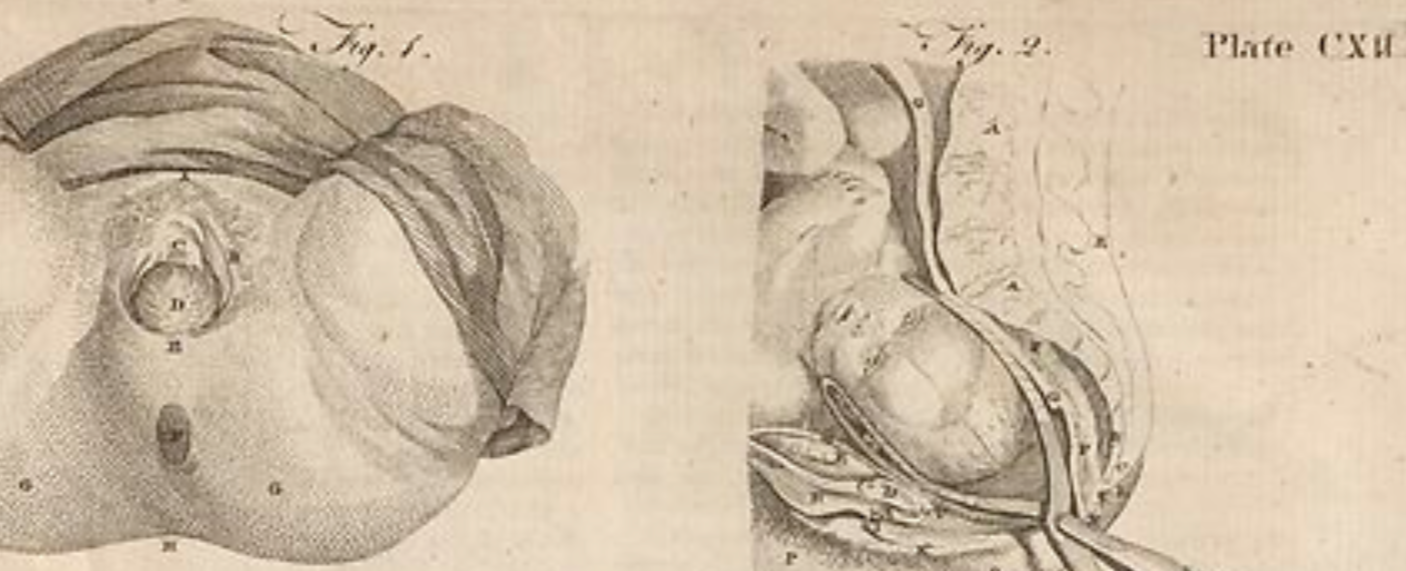
A striking example appears in the first edition of the Encyclopaedia Britannica, published in Edinburgh between 1768 and 1771. Its midwifery plates were explicit in the clinical sense: practical, educational and concerned with pregnancy and childbirth. They were not pornographic images. Yet the National Library of Scotland states that subscribers were scandalised by the explicit midwifery engravings and that King George III decreed that they be torn out of every copy. The Library also notes that its own copy retains the pages intact.
There is a further, more specific point about Plate 112. The National Library of Scotland page does not appear to identify Plate 112 by number in its account of the scandal. It refers to the midwifery engravings generally. However, rare-book catalogue records for first-edition Britannica sets commonly identify Plate 112, in the midwifery section, as the missing or facsimile plate. Christie’s, for example, has described a first edition with 159 of 160 numbered engraved plates, lacking number 112, present only in facsimile. Sotheby’s has similarly described a first edition lacking Plate 112 in the midwifery section.
That evidential distinction matters. It is stronger to say that the NLS documents a reported scandal about the midwifery engravings generally, while rare-book records identify Plate 112 as the commonly missing plate. 112 was not an emergency telephone number in 1771; but the later resonance is hard to resist: an image of reproductive anatomy was treated as if public knowledge itself required emergency suppression.
From obscenity to accuracy
The Britannica episode is revealing because the problem was not simply that bodies were shown. The deeper problem was that reproductive and genital knowledge was made visible in a public reference work. A page intended for education could be treated as indecent because it depicted anatomy that polite society preferred to hide.
The same tension persists in modern form. Many people still confuse vagina and vulva. Many institutions still require precise bodily knowledge while surrounding that knowledge with embarrassment, euphemism or adversarial theatre. Public culture often wants the benefits of anatomical knowledge without fully accepting the language and images required to teach it.
That contradiction has consequences.
Accurate terminology matters medically. People need words to describe pain, injury, infection, sexual function, childbirth, trauma and normal anatomy. Imprecise language can delay diagnosis, obscure symptoms and increase shame.
It matters legally. Courts depend on precise evidence. Where a statute uses a word differently from medicine, that difference should be made explicit, especially before juries.
It matters educationally. A society that cannot name body parts accurately is poorly equipped to teach consent, health, reproduction or bodily autonomy.
It also matters politically. Decisions about which anatomical images are acceptable, which words may be used, and which bodies may be described are never neutral. They reflect power: professional, legal, religious, patriarchal, commercial and institutional.
A small doorway into a larger problem
The history of genital anatomy is often treated as a history of obscenity. It may be better understood as a history of contested knowledge. Who is allowed to know? Who is allowed to teach? Who is allowed to name? Who decides whether a clinical image is educational or indecent?
The answer should not be left to embarrassment. Nor should it be left to courtroom theatrics. A serious public culture needs accurate anatomical language, careful legal explanation and an adult willingness to discuss bodies without prurience or shame.
In anatomy, a vagina is not the same thing as a vulva. In some legal contexts, however, “vagina” includes “vulva”, and references to body parts may include surgically constructed anatomy. That discrepancy is not a trivial oddity. It is a small doorway into a larger question: how does society translate bodies into words, and what happens when those words are used in medicine, law, education and power?
Suggested sources for readers
National Cancer Institute Dictionary of Terms: “vagina” and “vulva”.
National Library of Scotland Newsroom: “Library’s gift to the world to mark Britannica’s 250th anniversary”, 10 December 2018.
Various rare-book catalogue records for first-edition Encyclopaedia Britannica copies, noting missing or facsimile Plate 112.